NFL Weather Impact: Wind and Snow Effects on Betting Totals
 Available in US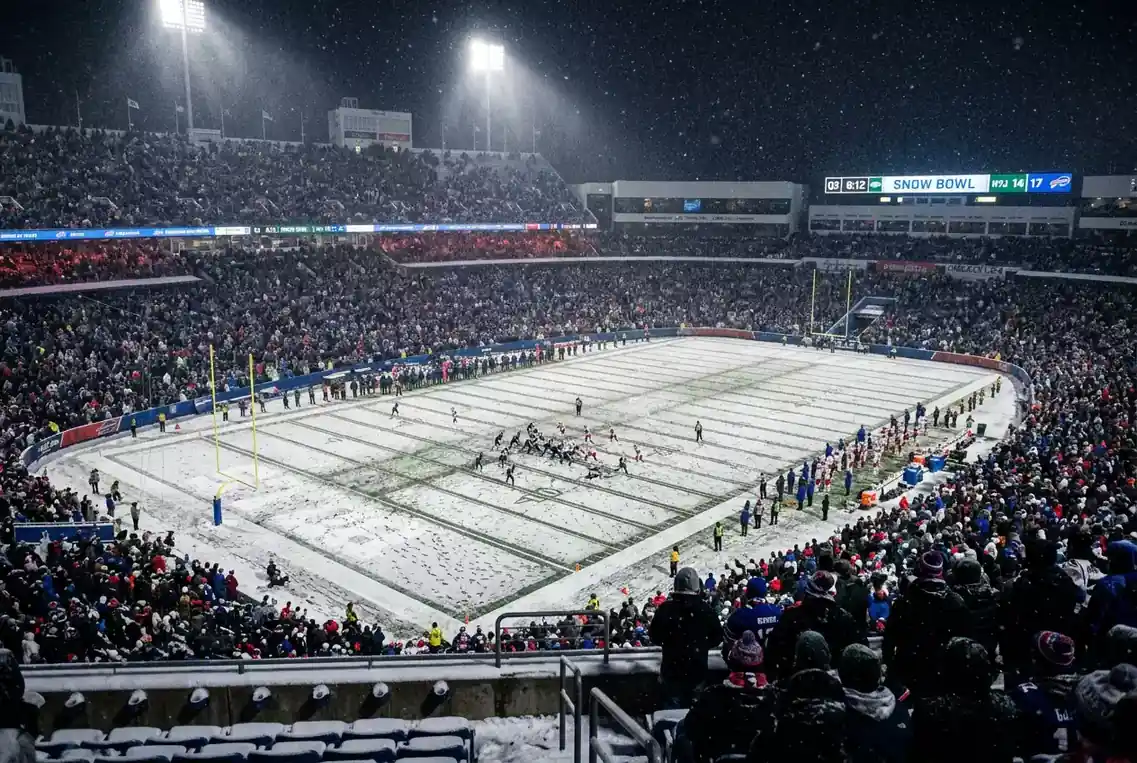
December 2023 – Bills versus Steelers in Orchard Park. The forecast called for sustained winds of 30 mph with gusts above 40. The total opened at 36.5, already low, and I still hammered the under. The game finished 31-17 – and I lost. The wind was real. Both offences adapted by running the ball aggressively, and the touchdowns still came. That afternoon taught me that weather is a factor, not a verdict, and the difference matters enormously for how you use it in your analysis.
Seventeen of the NFL’s thirty-two teams play at least some home games in outdoor stadiums exposed to the elements. Since 2007, the UK has hosted over 39 regular-season NFL games – all of them in controlled environments at Wembley and Tottenham Hotspur Stadium. The contrast is stark: London fixtures eliminate weather entirely, while a January game in Green Bay or Chicago can be shaped by conditions that no indoor setting replicates.
Severe weather conditions, particularly high winds, will dramatically shift the lines for NFL totals and over/under markets before kickoff.
NFL Wind Speed Effects on Passing Props and Match Totals
Wind is the weather variable I weight most heavily, because its impact on the passing game is measurable and consistent.
At sustained speeds below 10 mph, wind is statistically irrelevant. Completion percentages, passing yards, and scoring rates show no meaningful deviation from indoor baselines. Between 10 and 15 mph, there is a slight but detectable drag on deep passing – balls thrown more than 20 yards in the air are affected by crosswinds and headwinds, though shorter routes remain largely unaffected.
Above 15 mph is where I start adjusting my projections. Passing efficiency drops by roughly 5-8% compared to calm conditions, and quarterbacks become more reliant on short and intermediate routes. Field goals become less reliable, particularly from distances beyond 40 yards. I mark down my total projection by one to two points when sustained wind sits in the 15-20 mph range.
Above 20 mph, the impact escalates. Deep passes become unreliable, punts behave erratically, and field-goal accuracy falls off sharply. At these speeds I adjust my total projection downward by two to three points and shift my analysis toward rushing metrics and defensive performance. The bookmaker will have already adjusted the total, but in my experience the adjustment at the 20+ mph level is sometimes insufficient – particularly for games between two pass-dependent offences that lack a credible ground game.
Rain, Snow and Their Effect on Scoring
Rain is the most overrated weather factor in NFL betting. Light to moderate rain has minimal impact on scoring in the modern NFL. Ball technology has improved, field drainage at professional venues is excellent, and both teams play in the same conditions. I have tracked rain games over five seasons and found no statistically significant effect on totals unless the precipitation is severe enough to create standing water or reduce visibility.
Heavy rain – the kind that arrives with thunderstorms or sustained downpours for multiple quarters – is different. Fumble rates increase as ball security deteriorates, and offences that rely on precise timing routes see more drops and incompletions. But even in heavy rain, the effect on the total is smaller than the effect of equivalent wind. I adjust by one to one and a half points at most for heavy rain, and only if wind is not already a factor.
Snow is more impactful than rain but less consistent. Light snow on a dry surface plays like a normal game with slightly worse footing. Heavy snow on an accumulating surface compresses scoring dramatically – both teams shift to running plays, drives stall more frequently, and the game takes on a grind-it-out character. The famous “Snow Bowl” games in NFL history – where totals landed in the low twenties – are outliers, but they illustrate the ceiling of snow’s impact. In 2026, three London NFL games are scheduled across Tottenham and Wembley, with other international fixtures in München, Paris, Melbourne, and Mexico City – venues that range from controlled indoor environments to warm-weather outdoor settings, none of which present the snow variable that defines late-season domestic games.
Make informed decisions regardless of the forecast by checking the ultimate NFL betting resource every Sunday morning.
Dome Teams Playing in Winter Conditions
Here is where the weather analysis gets interesting for bettors: what happens when a team that plays its home games in a climate-controlled dome travels to an outdoor venue in December or January?
The conventional wisdom is that dome teams struggle in the cold. There is truth in that – dome-based offences are often built around the passing game, which benefits from indoor conditions, and their players are less accustomed to operating in freezing temperatures. But the effect is more nuanced than a blanket “fade the dome team outdoors.”
The key variable is the specific conditions, not the temperature alone. A dome team playing outdoors at 35 degrees Fahrenheit with no wind will perform only marginally worse than at home. The same dome team at 15 degrees with 20 mph gusts faces a genuinely hostile environment where scheme and personnel become liabilities. I differentiate between “cold but calm” road games, where the dome disadvantage is minimal, and “cold and windy” road games, where it is substantial.
I add roughly half a point to my spread estimate for a dome team playing outdoors in sub-freezing temperatures with wind, on top of any standard weather adjustment to the total. If the dome team is also travelling across multiple time zones for the fixture, the compounding effect of weather, travel, and unfamiliarity can push the adjustment closer to a full point. For a detailed look at how I approach the totals market specifically, including weather-driven analysis, I have covered the framework in my guide on NFL totals and over/under betting.
At what wind speed do NFL totals typically drop?
Sustained wind above 15 mph begins to measurably impact NFL scoring, primarily through reduced passing efficiency and less reliable field goals. Between 15 and 20 mph, totals projections should be adjusted downward by one to two points. Above 20 mph, the adjustment increases to two to three points, and above 25 mph the effect can be even more pronounced, particularly for pass-heavy offences.
Do dome teams perform worse outdoors in cold weather?
Dome teams face a measurable disadvantage in cold, windy outdoor conditions, primarily because their offensive schemes tend to favour the passing game, which is most affected by wind and cold. The effect is more pronounced when wind accompanies low temperatures than when temperatures are cold but conditions are calm. A half-point to one-point spread adjustment is reasonable for dome teams playing in sub-freezing, windy outdoor venues, depending on the severity of conditions.
Published by the nfl Betting Ofds team.