NFL Key Numbers: Point Spread Margins and Handicap Betting
 Available in US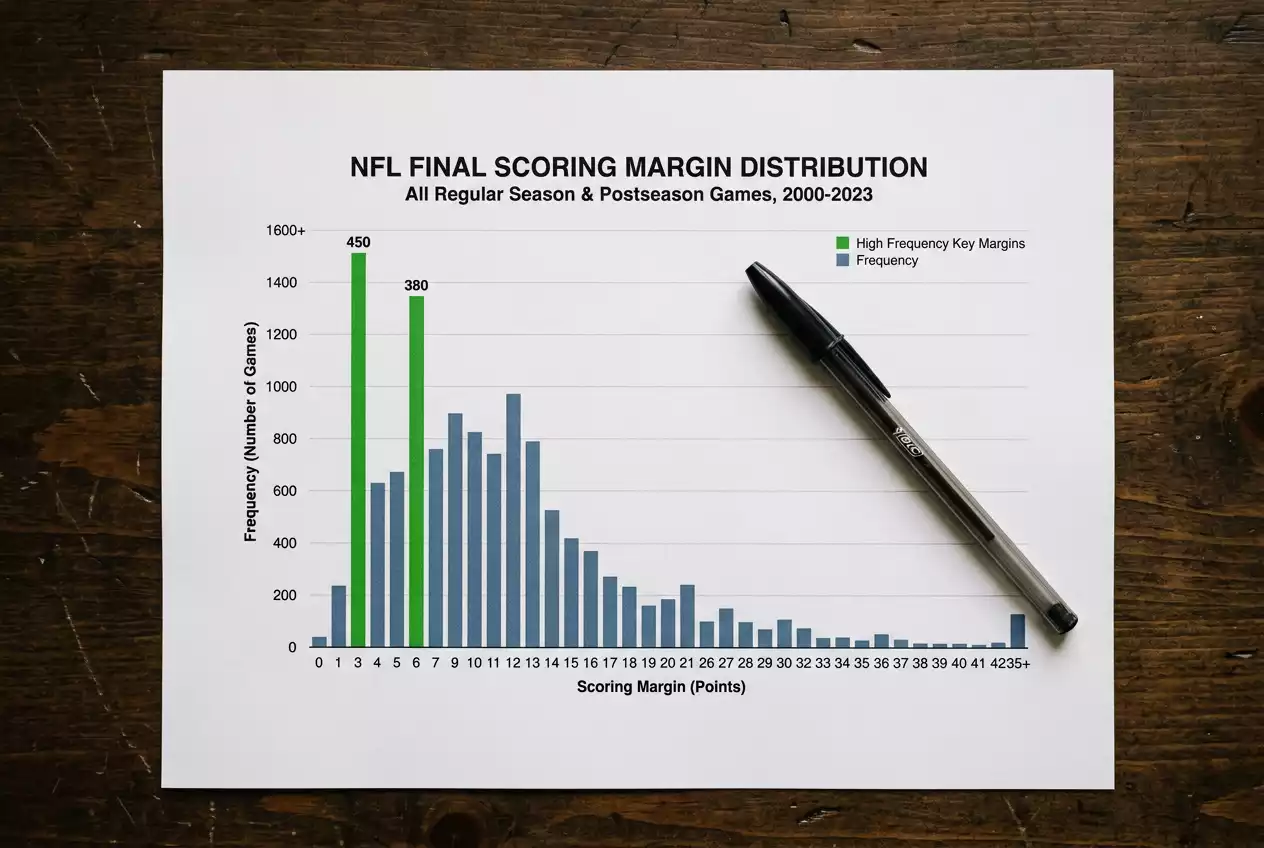
Three and seven. Those two numbers have cost me more sleep than any injury report, weather forecast, or last-second coaching decision combined. In NFL spread betting, final margins cluster around certain numbers with stubborn consistency, and understanding why is the difference between taking a good line and leaving money on the table.
Americans wagered a record 30 billion dollars on the 2025 NFL season through legal sportsbooks, per the American Gaming Association. A huge proportion of that handle flows through spread markets, and the bookmakers who set those lines know exactly how final margins distribute. If you want to compete in that market, you need to know it too.
NFL Final Scoring Margins and Key Number Spread Value
Football is a sport of field goals and touchdowns. A field goal is worth three points. A touchdown with the extra point is worth seven. These are the two most common scoring plays, and when a game is decided by a single scoring play, the margin lands on one of those numbers.
Across thousands of NFL games, roughly 15% finish with a final margin of exactly three points. Another 9% to 10% finish on exactly seven. Together, those two numbers account for nearly a quarter of all NFL outcomes. No other margin comes close in frequency. A margin of one accounts for about 5%. A margin of ten accounts for roughly 5%. The distribution has peaks at three and seven that tower above everything else.
This clustering has a direct consequence for spread bettors. If you are choosing between laying -2.5 and laying -3, the half-point difference is not trivial – it determines whether a game decided by exactly three points counts as a win or a push (or a loss, if you laid -3.5). That single half-point, on the most common margin in the sport, carries far more weight than a half-point shift at, say, -5 or -8, where final margins are less concentrated.
I keep a printed distribution chart pinned above my desk. Every time I consider a spread near a key number, I glance at the chart before placing the bet. The visual reminder prevents me from treating all half-points as equal. They are not.
Buying Points: When Half a Point Is Worth the Juice
Most UK sportsbooks allow you to “buy” points on NFL spreads – moving the line in your favour by half a point in exchange for worse odds. The question is whether the cost is justified, and the answer depends entirely on which number you are buying through.
Buying from -3 to -2.5, or from +2.5 to +3, moves you across the single most important number in NFL scoring. That half-point protects you from the 15% of games that land on exactly three. The typical cost of buying half a point is ten to fifteen cents on the odds (from -110 to roughly -120 or -125), which translates to an implied probability shift of about 2-3%. Since the protection covers roughly 15% of outcomes, the maths strongly favours buying through three.
The same logic applies, to a lesser extent, at seven. Buying from -7 to -6.5, or +6.5 to +7, crosses the second-most common margin. The protection here covers about 9-10% of games, and the typical cost is similar. The value is still positive but less dramatic than at three.
At every other number, buying half a point is almost never worth the juice. Margins of four, five, six, eight, and nine each occur in only 4-6% of games, which means the protection you are buying is roughly equal to or less than the extra cost you are paying. I have a hard rule: I buy points through three and seven, and nowhere else. Everything outside those two numbers gets bet at the market price.
Secondary Key Numbers: 4, 6 and 10
After three and seven, the distribution does not simply flatten into noise. A few secondary numbers show up often enough to influence how I approach certain lines.
Four occurs when a team wins by a field goal and a safety (rare) or when a conversion attempts change the arithmetic after touchdowns. Its frequency – around 4-5% of games – makes it a minor but noticeable factor. More practically, the gap between a spread of -3.5 and -4.5 matters slightly more than the gap between -4.5 and -5.5 because of the four-point cluster.
Six appears when a team scores a touchdown but misses the extra point (or opts for a failed two-point conversion), and the game is decided by that single score. It shows up in roughly 4-5% of outcomes, and its relevance is growing as coaches become more aggressive with two-point conversion attempts.
Ten is a touchdown-plus-field-goal margin, and it clusters at about 5% frequency. Spreads in the 9.5 to 10.5 range are relatively rare in NFL lines – most games do not have that large a projected difference between the teams – but when they do appear, the ten-point cluster is worth noting. I have seen games where the market posts a spread of -9.5, and public money pushes it to -10 or -10.5, crossing the key number and creating value on the side that received the extra points.
Understanding these secondary numbers does not replace the fundamental importance of three and seven, but it adds precision to your line evaluation. When I look at a spread, I mentally map it against the distribution chart: Am I crossing a key number? Is the market offering me the right side of a cluster? If the answer to both is yes, the bet gets a higher confidence rating in my weekly analysis.
Super Bowl LX generated 1.76 billion dollars in legal US handle, per Legal Sports Report and AGA data, and the spread market on that single game attracted some of the heaviest action of the year. The key-number dynamics apply to the Super Bowl just as they do to any regular-season fixture – possibly more so, because the concentrated attention means bookmakers price the line with extreme precision, and every half-point of movement is heavily scrutinised.
For a complete breakdown of how spreads work mechanically – how the line is set, why it moves, and how to read it in fractional format – I have covered everything in the NFL point spread betting guide. Key numbers are the final layer of refinement that sits on top of that foundation.
What are the most important key numbers in NFL point spread betting?
Three and seven are the dominant key numbers. Approximately 15% of NFL games finish with a margin of exactly three points, and 9-10% finish at exactly seven. Together these two margins account for nearly a quarter of all outcomes. Spreads that cross these numbers carry significantly more value per half-point than spreads at other numbers.
Is buying half a point worth the extra juice?
Buying through the number three is almost always worthwhile because it protects against the most common margin in the sport. Buying through seven is also positive value in most cases. At all other numbers, the frequency of the margin is too low to justify the typical cost of ten to fifteen cents on the odds, making the purchase a losing proposition over time.
Published by the nfl Betting Ofds team.