NFL Strength of Schedule: Impact on Win Totals and Point Spreads
 Available in US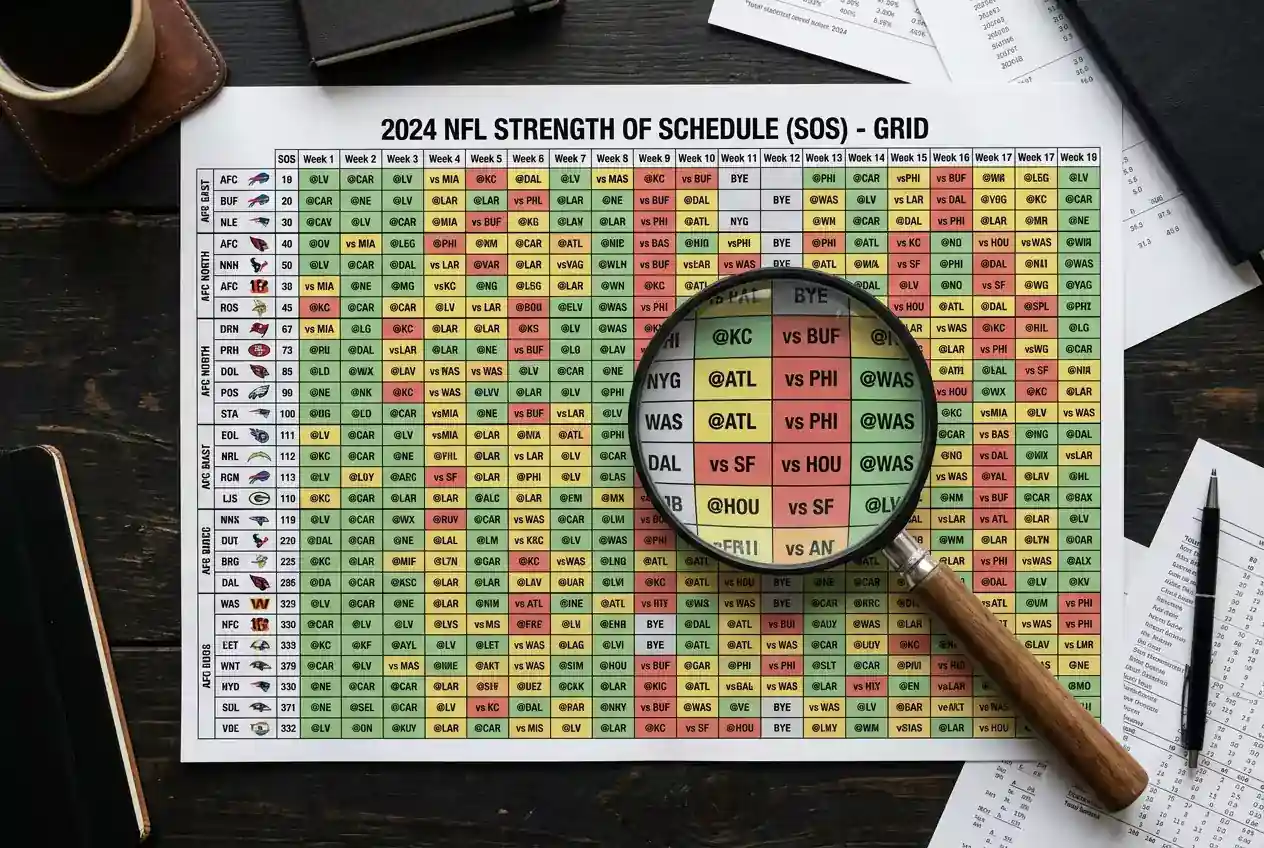
Two seasons ago I backed a team for the division title at +350 based largely on their soft projected schedule. They started 5-1, and I felt like a genius. Then the easy portion ended, the next six opponents were all above .500, and they finished 8-9. Strength of schedule gave me the right opening thesis and the wrong conclusion – because I treated it as the whole picture instead of one chapter. That mistake shaped my entire approach to SOS in betting.
The NFL’s international calendar continues to expand – Roger Goodell has publicly targeted sixteen international games per season, with every team eventually playing one game abroad. That structural shift will add another layer to schedule analysis, as teams contending with transatlantic travel face a different kind of difficulty than a tough divisional matchup. For now, the fundamentals of strength of schedule remain the starting point.
NFL Strength of Schedule Calculation and Futures Betting
The core calculation is simple: take the combined win-loss record of all opponents a team will face (or has faced) and express it as a winning percentage. A team whose opponents have a collective .530 winning percentage has a harder schedule than one whose opponents sit at .470.
Pre-season SOS is based on the previous year’s records. This is the version you see on draft weekend and in off-season preview articles. It has a glaring limitation: it assumes last year’s teams are this year’s teams, which ignores free agency, the draft, coaching changes, injuries, and regression. A team that went 13-4 last year might go 8-9 this year, and the schedule that looked murderous in May is suddenly manageable by October.
In-season SOS adjusts as actual results come in. By mid-season, the remaining schedule can be recalculated using current records, which provides a more accurate picture. I refresh my SOS estimates every four weeks during the regular season and use the updated figures to reassess futures positions and season win total bets.
More sophisticated versions of SOS weight opponents by quality rather than treating every game equally. Playing a 12-win team twice in divisional matchups should carry more weight than playing a 7-win team once in a cross-conference fixture. I use a weighted SOS model that incorporates DVOA-based team ratings rather than raw win-loss records, which reduces the noise from schedule imbalances.
Where SOS Matters: Futures, Win Totals and Weekly Lines
SOS is most useful for long-horizon bets – the kind where the full shape of the schedule determines the outcome. The American football market globally is valued at 26.65 billion dollars in 2025, per Statista, and a meaningful share of that value cycles through futures and season-long markets where schedule analysis pays dividends.
Season win totals are the market where SOS has the clearest application. If a bookmaker posts a win total of 10.5 for a team whose schedule ranks in the bottom five for difficulty, the over becomes more attractive because the team faces fewer tough opponents than average. Conversely, a team with a top-five hardest schedule may struggle to reach even a modest win total, regardless of talent.
Futures – Super Bowl, conference, and division winners – benefit from SOS analysis in a different way. A team with a soft schedule is more likely to earn a high seed, which means home-field advantage in the playoffs and potentially a first-round bye. That structural advantage ripples through the probability of winning the conference and ultimately the championship. I weight SOS more heavily for division winner bets than for Super Bowl futures, because divisional outcomes are more directly affected by schedule difficulty than post-season tournament results.
For weekly spread and totals betting, SOS matters less. The specific matchup – the two teams on the field, their injuries, their recent form – dominates the line. Schedule context provides background (is this team fatigued from a stretch of tough games?) but rarely changes my weekly bet by more than a quarter of a point.
Why Strength of Schedule Alone Is Not Enough
If SOS were a reliable standalone predictor, every analytics-savvy bettor would already be exploiting it, and the market would have priced it in. The reality is more complicated.
The biggest limitation is predictive instability. Pre-season SOS is based on last year’s data, which degrades rapidly as roster turnover reshapes the league. A study I ran across five NFL seasons found that pre-season SOS had a correlation of roughly 0.35 with actual in-season SOS – meaning it explains only about 12% of the variance. That is not useless, but it is a long way from reliable.
The second limitation is that SOS does not account for matchup-specific dynamics. A team with a “hard” schedule might face three elite pass defences, which is devastating for a pass-heavy offence but less concerning for a run-first attack. Aggregate difficulty conceals these specifics, and the specifics are what determine game outcomes.
The third limitation is public perception. Casual bettors and media narratives overweight SOS, especially in the off-season. A team widely described as having the “easiest schedule in the NFL” attracts disproportionate futures money, which shortens its odds beyond fair value. By the time you notice the soft schedule, the market may have already priced it in – or overpriced it. I use SOS as a filter to identify candidates for deeper analysis, not as a signal to bet. If the schedule is soft and the underlying metrics support the team’s quality, I lean in. If the schedule is the only argument, I pass.
For a framework on how to evaluate those underlying metrics – EPA, DVOA, and ATS trends – alongside schedule analysis, I have written a separate guide on advanced metrics for NFL betting.
How is NFL strength of schedule calculated?
The basic calculation takes the combined win-loss record of all opponents a team faces and expresses it as a winning percentage. Pre-season SOS uses the previous year’s records, while in-season SOS updates as current results accumulate. More advanced models weight opponents by quality metrics like DVOA rather than raw records, providing a more nuanced picture of schedule difficulty.
Should I use strength of schedule for weekly NFL bets or just futures?
SOS is most impactful for long-horizon bets like season win totals, division winners, and Super Bowl futures, where the cumulative difficulty of the entire schedule matters. For weekly spread and totals betting, the specific matchup between the two teams on the field is far more influential than their broader schedule context. SOS can provide background on fatigue or momentum from recent tough games, but it rarely shifts a weekly line by a meaningful amount.
Prepared by the nfl Betting Ofds editorial staff.